
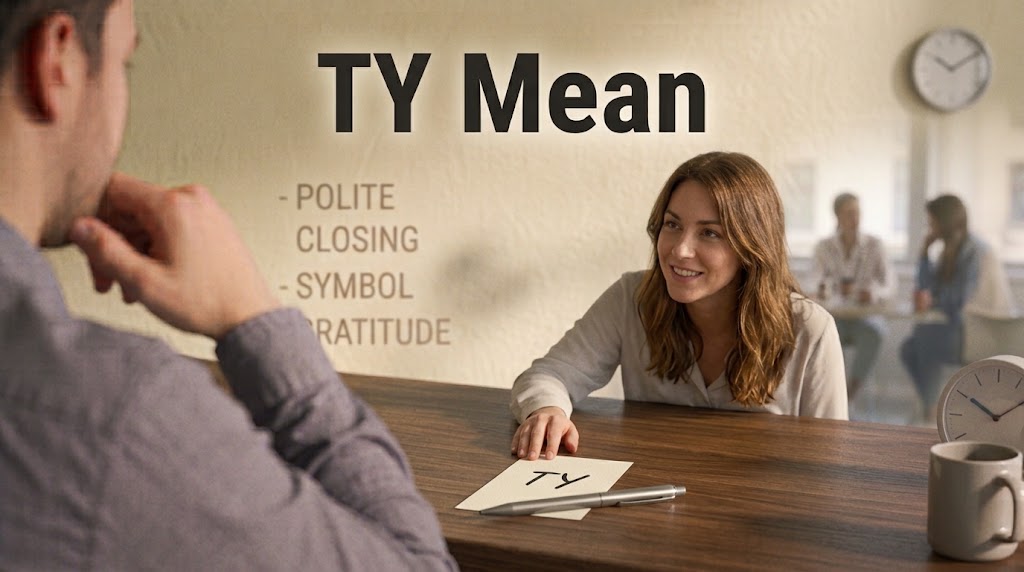
TY usually means “thank you” in a text message or online conversation. It is a short abbreviation people use when they want to thank someone quickly. You may see “TY” in texts, TikTok comments, Snapchat messages, Instagram DMs, WhatsApp chats, and other casual online conversations.
If someone sends you “TY,” they are usually simply saying thanks. For example, if you send a friend a photo they asked for and they reply “TY!”, they mean “Thank you!”
People often search for the meaning of TY because internet abbreviations can be confusing, especially when someone uses one without explaining it. The good news is that TY is one of the simpler texting abbreviations to understand.
TY Meaning in Text
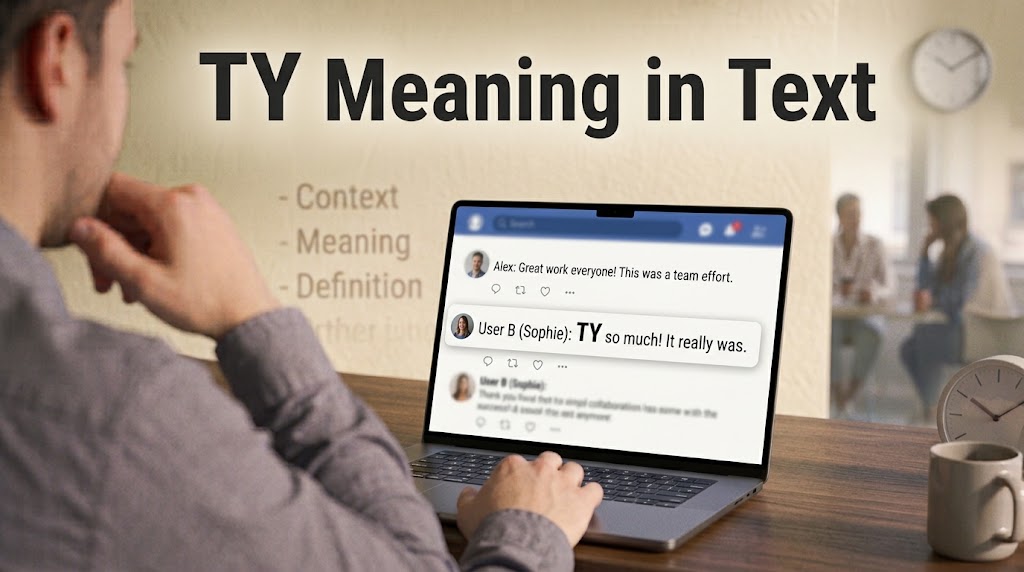
In text messages, TY means “thank you.” It is an abbreviation rather than a separate word or piece of slang.
People use it to save time while typing. Instead of writing “thank you,” they can simply type “TY.” It is especially common in quick, informal conversations.
For example:
A: I sent you the notes from class.
B: TY!
Here, “TY” simply means “Thank you!”
You might also see variations such as TYSM, which means “thank you so much,” or TY!!, where the extra exclamation marks make the message feel more enthusiastic.
Is TY an acronym or abbreviation?
TY is generally best described as a texting abbreviation or initialism. It comes from the first letters of the two words in “thank you.”
Unlike some slang terms that have developed their own meanings, TY is quite literal. The letters T and Y represent the beginning of “thank” and “you.”
You do not need to treat TY as a complicated piece of internet slang. It is simply a shorter way of saying thanks.
What does TY mean in everyday chat?
In everyday conversation, TY can mean:
- Thank you
- Thanks
- Thanks a lot, depending on the context
- I appreciate it, in some situations
The exact feeling depends on the rest of the message.
For example, “TY!” may sound cheerful and appreciative, while “ty” can feel very casual. That does not necessarily mean the person is being cold or rude. Some people naturally type in lowercase or prefer very short messages.
TY vs. thank you
There is usually no major difference in meaning between “TY” and “thank you.” The biggest difference is tone and formality.
“Thank you” sounds more complete and can be appropriate in formal situations.
“TY” is quicker and more casual. It works well when texting friends, replying to social media comments, or chatting online.
For example:
Casual:
“TY for sending that!”
More formal:
“Thank you for sending that.”
Both express appreciation, but the second sounds more polished.
Where People Use TY
TY appears in many forms of online communication. Because it is short and easy to type, it works particularly well in fast-moving conversations.
You can find it on TikTok, Snapchat, Instagram, WhatsApp, and regular SMS messages.
TY on TikTok
On TikTok, TY may appear in comments, direct messages, or replies.
Someone might comment:
“TY for explaining this!”
They simply mean:
“Thank you for explaining this!”
TikTok comments are often short, so abbreviations like TY are convenient.
You may also see someone write “tysm,” meaning “thank you so much.” The two expressions are related, but TY is shorter.
TY on Snapchat
Snapchat conversations tend to be casual and quick, which makes TY a natural abbreviation.
For example:
“I saved the pic for you.”
“TY!”
A Snapchat user may also send “ty” after receiving a photo, answer, recommendation, or favor.
Because Snapchat messages are often informal, there is usually no need to write the full phrase “thank you.”
TY on Instagram
On Instagram, TY can appear in DMs and comments.
For example, if someone asks for a recommendation and receives one, they might respond:
“TY!! I’ll check it out.”
It can also be used when responding to compliments:
“Your outfit looks great!”
“TY 😊”
In this case, TY is just a friendly way of accepting the compliment.
TY on WhatsApp
WhatsApp conversations can range from very casual chats with friends to family and group conversations.
TY is common when people are messaging quickly.
For example:
“I’ll pick up the groceries on my way home.”
“TY!”
The person is thanking the other person for doing the favor.
In a family group chat, you might also see:
“TY everyone for the birthday wishes!”
The abbreviation is not limited to teenagers or younger users. Anyone familiar with texting shorthand may use it.
TY in SMS
TY can also be used in ordinary SMS texting.
For example:
“I left your keys at the front desk.”
“TY, I’ll get them later.”
SMS conversations are often brief, and abbreviations help people type quickly.
However, if you are texting a teacher, manager, customer, or someone you do not know well, writing “thank you” may be a better choice. The full phrase sounds more professional.
Real Chat Examples
Seeing TY in actual conversations makes the meaning much easier to understand. Here are some realistic examples of how people might use it.
Example 1: Asking for notes
A:
Can you send me the notes from yesterday?
B:
Yeah, give me a minute.
A:
TY!
Here, TY means “thank you” for sending the notes.
Example 2: Receiving a photo
A:
Did you get that picture from last night?
B:
Yep, sending it now.
A:
TY 😊
The person is thanking their friend for sending the photo.
Example 3: Getting directions
A:
The restaurant is on the second floor, next to the cinema.
B:
Ohh okay, ty!
The “ty” is simply a quick thank-you.
Example 4: Responding to a compliment
A:
Your new profile pic looks really good.
B:
TY!!
The extra exclamation marks make the response sound more enthusiastic.
Example 5: Getting help with homework
A:
What did you get for question 6?
B:
I got 42.
A:
TY, that’s what I got too.
Here, TY is being used as a quick acknowledgment.
Example 6: A friend doing a favor
A:
I grabbed your coffee while I was out.
B:
Wait seriously? TY!!
The abbreviation expresses appreciation for the favor.
Example 7: Social media recommendation
A:
What show were you talking about yesterday?
B:
It’s called The Bear. You should watch it.
A:
TY, adding it to my list.
Again, TY means “thank you.”
Example 8: Birthday wishes
A:
Happy birthday!! Hope you have an amazing day!
B:
TYSM!! ❤️
Here, the person uses TYSM rather than TY. TYSM means “thank you so much.”
Example 9: Group chat
A:
I uploaded all the photos from the trip.
B:
TY! They look great.
C:
Ty, downloading them now.
Both replies use TY as a casual thank-you.
Example 10: Quick response
A:
I found the link you wanted: [link]
B:
ty
A:
No problem!
The lowercase “ty” does not automatically make the response unfriendly. It is simply a very casual form of the abbreviation.
How to Reply When Someone Says “TY”
If someone sends you “TY,” you usually do not need to think too hard about your response. They are thanking you, so a simple acknowledgment is enough.
Your reply can depend on how close you are to the person and how casual the conversation is.
Funny replies
If you are joking around with a friend, you could respond with something playful:
- “You’re welcome, citizen.”
- “Anytime 😎”
- “I accept payment in snacks.”
- “You’re welcome 😂”
- “That’ll be $5.”
- “Glad my services were useful.”
- “No problem, I do what I can.”
These work best with people who understand your sense of humor.
Casual replies
For everyday conversations, keep it simple:
- “Np!”
- “No problem!”
- “Ofc!”
- “Anytime!”
- “You got it.”
- “Sure!”
- “All good!”
“NP” means “no problem,” while “OFC” means “of course.”
Friendly replies
If you want to sound warm and positive, you could say:
- “You’re very welcome!”
- “Of course 😊”
- “Anytime!”
- “Happy to help!”
- “No worries!”
- “Glad I could help!”
These are especially useful when you want to sound friendly without making the conversation overly formal.
Neutral replies
Sometimes you do not need a special response at all.
Depending on the situation, you can simply say:
- “Sure.”
- “Yep.”
- “No problem.”
- “Okay!”
- “You’re welcome.”
You can also continue the conversation without directly acknowledging the “thank you.”
For example:
A: TY!
B: Want me to send the other photo too?
That is completely natural in texting.
Is TY Rude or Offensive?
No, TY is not normally rude or offensive. It is a common and harmless way to say “thank you.”
The important thing is context.
When you are talking with friends, classmates, relatives, or people you regularly chat with online, using TY is usually perfectly fine.
Is TY too informal?
TY is definitely informal. That does not make it bad, but it means you should think about who you are talking to.
For example, sending “TY” to your best friend is normal.
Sending “TY” to a professor after they respond to an important academic question might seem overly casual. “Thank you” would usually be a better choice.
Likewise, in a professional email, application, business message, or formal letter, spelling out “thank you” is generally safer.
Is TY appropriate at school?
In casual messages between students, TY is fine.
For example:
“TY for sending the homework.”
However, when writing an assignment, emailing a teacher, or submitting a formal school document, use “thank you” instead.
The same basic rule applies at work.
Is TY safe to use?
Yes. TY does not contain an offensive meaning in normal texting use.
Of course, internet abbreviations can sometimes have unusual meanings in very specific communities. Context always matters, but the overwhelmingly common meaning of TY in everyday texting is “thank you.”
Who Uses This Term?
TY is used by people who communicate through digital messages, especially when conversations are informal.
It is not limited to one specific age group.
Teenagers and young adults
Teenagers and young adults may use TY frequently because short abbreviations are common in texting and social media communication.
A quick “ty” can be easier than typing the entire phrase.
Gen Z usage
Gen Z is familiar with TY and many similar abbreviations, including:
- LOL — laughing out loud
- IDK — I don’t know
- IDC — I don’t care
- IMO — in my opinion
- BRB — be right back
- TYSM — thank you so much
That does not mean every Gen Z user uses these abbreviations constantly. Internet language changes quickly, and people have different texting habits.
Older users
Older adults can also use TY, especially if they regularly text or use social media.
Once an abbreviation becomes familiar, it is not necessarily tied to a particular generation.
Common platforms
TY can appear across many platforms, including:
- TikTok
- Snapchat
- Discord
- Online forums
- SMS
- Private messages
- Gaming chats
It is particularly useful anywhere people have short, informal conversations.
How often does TY appear online?
TY is a fairly familiar texting abbreviation, although the exact frequency depends on the platform and the person.
Some people prefer “thanks,” while others write “thank you,” “thx,” “ty,” or “tysm.”
There is no single correct version. People choose whichever style feels natural to them.
Origin of the Term
The exact moment when TY first appeared is difficult to identify, but its development is closely connected to the rise of internet culture, instant messaging, texting, and online chat.
The logic behind the abbreviation is straightforward: take the first letters of “thank you” and use them as a shortcut.
As online communication became faster and more conversational, people began shortening common phrases to save time and typing effort.
TY belongs to the same general family of abbreviations as IDK, BRB, IMO, and LOL.
Early internet chatrooms and instant messaging helped popularize this style of communication. Mobile texting later made short forms even more convenient because people were often typing on small phone keyboards.
There is not one universally accepted person, website, or event that can be credited with inventing TY. Its origin is better understood as part of the broader evolution of digital shorthand.
In other words, TY did not necessarily emerge from one specific slang community. It developed naturally because “thank you” is a very common phrase, making it an obvious candidate for shortening.
TY vs. Other Common Text Abbreviations
TY is just one of many short expressions used in digital conversations. Here is how it compares with a few other familiar abbreviations.
| Abbreviation | Meaning | Type | Usage | Popularity |
|---|---|---|---|---|
| TY | Thank you | Texting abbreviation | Expressing thanks | Very common |
| IDK | I don’t know | Texting abbreviation | Showing uncertainty or lack of knowledge | Very common |
| IDC | I don’t care | Texting abbreviation | Expressing indifference | Common |
| IMO | In my opinion | Texting abbreviation | Giving an opinion | Common |
| BRB | Be right back | Texting abbreviation | Temporarily leaving a chat | Well known |
These abbreviations have slightly different roles.
TY expresses gratitude.
IDK communicates uncertainty.
IDC expresses a lack of concern or interest.
IMO introduces an opinion.
BRB tells someone that you are temporarily stepping away.
Because they are short, these expressions are especially useful in quick conversations.
Real-World Usage Example
Imagine that two friends are planning to meet after school.
One friend sends a message:
Friend 1: I can pick you up at 6 if you want.
Friend 2: That would be great, ty!
Friend 1: No problem. See you then.
In this situation, “ty” is simply a quick way for Friend 2 to say “thank you.”
There is no hidden meaning. It is not sarcastic by default, and it is not offensive.
The same thing could happen in many ordinary situations. Someone might thank a friend for sending a document, sharing a location, recommending a restaurant, explaining homework, forwarding a photo, or doing a small favor.
The abbreviation is useful because the person does not need to type out the entire phrase.
Tone can still depend on context, though.
For example:
“ty ❤️”
can feel warm and affectionate.
Meanwhile:
“ty”
may feel more neutral and brief.
But it would be a mistake to assume that a short “ty” is automatically rude. Many people simply have a short texting style.
If you are unsure about someone’s tone, look at the entire conversation rather than judging one abbreviation by itself.
Frequently Asked Questions
What does TY mean in text messages?
TY means “thank you.” It is a common texting abbreviation used to express appreciation quickly and casually.
What does TY mean on TikTok?
On TikTok, TY usually means “thank you.” You may see it in comments, replies, or direct messages when someone is thanking another person.
Is TY slang?
TY is more accurately described as a texting abbreviation or initialism rather than traditional slang. It is a shortened form of “thank you.”
Is TY rude or offensive?
No. TY is generally not rude or offensive. It is casual, though, so “thank you” may be more appropriate in formal school, business, or professional situations.
How should you reply to TY?
You can reply with “you’re welcome,” “no problem,” “anytime,” “of course,” or simply continue the conversation. With friends, a funny response can also work.
A Few Similar Expressions You May See
Once you understand TY, you may notice other versions of the same idea.
TYSM
TYSM means “thank you so much.”
Example:
“TYSM for helping me!”
This is more enthusiastic than a basic “TY.”
THX
THX is another shortened form of “thanks.”
Example:
“THX for the link!”
It has a similar purpose to TY, although the wording is slightly different.
Thanks
Sometimes people simply write “thanks,” which is already short enough that no abbreviation is needed.
For example:
“Thanks for letting me know!”
This is still casual but may sound a little more natural than an abbreviation in some conversations.
TYVM
TYVM means “thank you very much.”
It is less common in everyday conversations than TY, but you may still encounter it online.
The important point is that these expressions all communicate some form of appreciation. The difference is mainly in wording, tone, and personal texting style.
When Should You Use TY?
TY is a good choice when the conversation is informal and fast-moving.
You can comfortably use it with:
- Close friends
- Family members
- Classmates
- Online friends
- Social media followers
- Gaming friends
- People you regularly message
It can be particularly useful when you want to acknowledge something quickly without interrupting the flow of a conversation.
For example:
“I found the link you needed.”
“TY!”
That’s perfectly natural.
If you are speaking with someone in a formal setting, however, consider writing the full phrase.
Instead of:
“TY for getting back to me.”
you might write:
“Thank you for getting back to me.”
The second version is clearer and more professional.
When Should You Avoid TY?
There is no major safety concern around TY, but there are situations where a more formal expression is simply better.
Avoid relying on TY in:
- Formal emails
- Job applications
- Cover letters
- Professional reports
- Official school assignments
- Messages to customers
- Formal requests
- Important business communication
This does not mean TY is wrong. It is simply a matter of matching your language to the situation.
A useful rule is simple:
Casual conversation = TY is fine.
Formal communication = write “thank you.”
That one distinction will cover most situations.
Final Thoughts
TY means “thank you” in text messages and online conversations. It is a short, informal abbreviation that people use when they want to show appreciation without typing the full phrase.
You may see TY on TikTok, Snapchat, Instagram, WhatsApp, SMS, gaming platforms, and other online spaces. It is especially common in quick, casual conversations.
TY is not normally rude or offensive. However, because it is informal, you may want to write “thank you” when talking to a teacher, employer, customer, or someone in another professional setting.
If someone sends you “TY,” a simple response such as “you’re welcome,” “no problem,” “anytime,” or “of course” is all you need. So, the next time you see “TY” in a message, you can read it simply as “thank you.”
Discover more post
What Does XD Mean in a Text Mean? 2026
What Does What Do Ight Mean in Text? 2026
What Does NVR Mean in Text? Real Meaning, Examples & Social Media Use 2026
