

SFS usually means “Shoutout for Shoutout” in text and social media conversations. It describes a mutual promotion where two people agree to mention or promote each other’s accounts. On Snapchat, SFS can also mean “Snap for Snap.”
You may see SFS in a TikTok comment, Snapchat message, Instagram Story, WhatsApp chat, or even a regular text message. The exact meaning can depend on the app and the conversation.
People often search for the meaning because SFS is one of those short internet abbreviations that makes sense once you know it, but can be confusing when you see it for the first time.
If someone simply messages you “SFS?”, they are usually asking whether you want to exchange a shoutout or, on Snapchat, possibly exchange snaps. The surrounding conversation usually tells you which meaning they have in mind.
SFS Meaning in Text
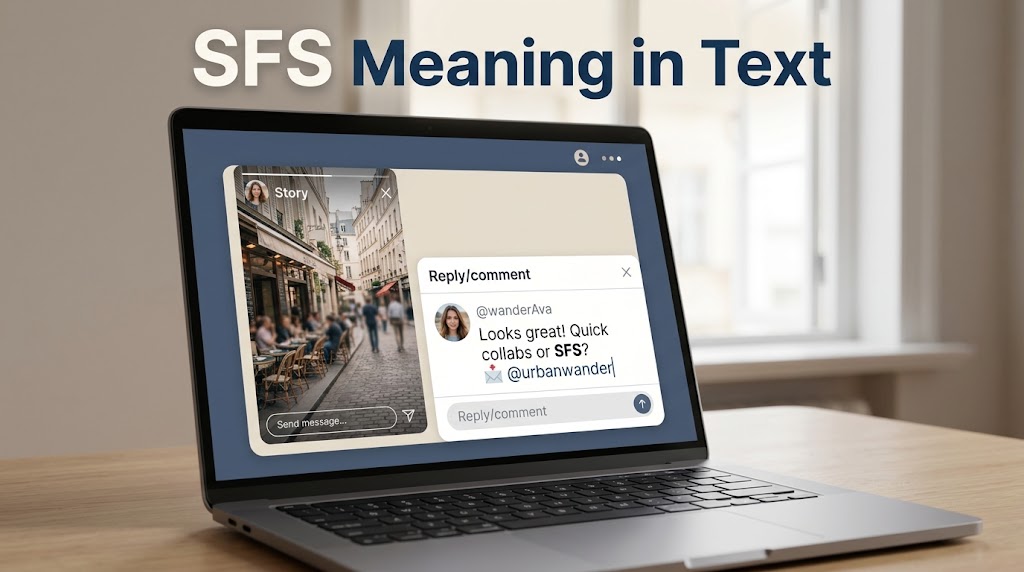
The most common meaning of SFS in text is “Shoutout for Shoutout.”
In simple terms, it means:
You promote me, and I’ll promote you.
For example, imagine you have an Instagram account with 2,000 followers and another person has an account with a similar audience. You might agree to post each other’s usernames on your Stories.
You share their account.
They share yours.
That is an SFS.
A shoutout can be as simple as tagging someone in a Story, sharing their post, mentioning their username, or telling your followers to check out their account. The main idea is that the promotion is mutual.
Is SFS an acronym or abbreviation?
SFS is commonly described as an initialism or abbreviation because the letters represent the first letters of the words in “Shoutout for Shoutout.”
People normally say the individual letters—“S-F-S”—rather than treating it like an ordinary word.
It belongs to the larger group of internet shorthand that includes terms such as IDK, IDC, IMO, BRB, F4F, and L4L.
The important thing is not the technical label, though. What matters when you’re texting is understanding what the sender is asking.
What does “SFS?” mean by itself?
If someone sends:
“SFS?”
they are usually asking:
“Do you want to do a shoutout for shoutout?”
If this happens on Instagram, “Shoutout for Shoutout” is generally the most natural interpretation.
On Snapchat, there is another common possibility: “Snap for Snap.” In that case, the person may be asking you to exchange snaps rather than publicly promote each other.
That is why context matters.
For example:
“SFS? I’ll put you on my Story.”
This almost certainly means Shoutout for Shoutout.
But:
“SFS? Send one back.”
could mean Snap for Snap, particularly in a Snapchat conversation.
Other variations, including “Spam for Spam,” have also been documented in social-media slang. This generally refers to mutually interacting with or promoting each other’s posts.
SFS in everyday chat
SFS is casual language. It is much more likely to appear in a DM, Story, comment, or group chat than in formal writing.
Someone might write:
“Anyone down for SFS?”
Or:
“Doing SFS today. DM me.”
Or:
“Wanna SFS?”
The basic idea is usually mutual support or promotion.
It can be particularly common among people who are trying to grow a social-media account, promote a small creator page, introduce friends to each other, or increase visibility.
Where People Use SFS
SFS is closely associated with social media, but the way people interpret it can change from one platform to another.
Here is what you are most likely to encounter.
SFS on TikTok
On TikTok, SFS can refer to a mutual promotion between creators or users.
For example, someone might comment:
“SFS?”
They could be asking whether you want to promote each other’s accounts.
The exact method varies. One person might mention the other account in a video, comment, Story, or other social post, while the other person returns the favor.
TikTok users may also use SFS alongside other growth-related expressions such as “follow for follow” or “F4F.” However, these terms are not identical.
F4F generally means Follow for Follow, while SFS usually involves some kind of shoutout or promotional exchange.
SFS on Snapchat
Snapchat is where SFS can become slightly confusing.
On Snapchat, SFS can mean “Shoutout for Shoutout” or “Snap for Snap.” Both meanings have been documented in social-media slang references.
If someone is talking about Stories, followers, or promoting accounts, they probably mean Shoutout for Shoutout.
If they are talking about sending pictures or videos back and forth, they may mean Snap for Snap.
For example:
“SFS on my story?”
probably means:
“Will you give me a shoutout on your Story if I give you one?”
But:
“SFS? Send me a snap.”
is more likely asking for a snap exchange.
When you’re unsure, there is nothing wrong with asking what they mean.
SFS on Instagram
Instagram is another common place to see SFS.
People may use it in:
- Stories
- DMs
- Comments
- Captions
- Creator communities
- Promotional posts
An Instagram SFS usually involves two accounts promoting each other.
For example, a person might post:
“SFS with @username”
and then share that account with their followers.
The other person is expected to do something similar in return.
This can be especially useful for smaller creators because each person gets exposure to an audience they might not otherwise reach.
SFS on WhatsApp
SFS is less standardized on WhatsApp than on Instagram or Snapchat.
If you see it in a WhatsApp chat, the best approach is to look at what the conversation is about.
If two friends are discussing social-media accounts, SFS may mean Shoutout for Shoutout.
If they have been discussing Snapchat, it could mean Snap for Snap.
WhatsApp itself does not give SFS one official meaning. It is simply an abbreviation people bring into their conversations from wider internet culture.
SFS in SMS or regular texting
SFS can appear in ordinary text messages, too.
However, it is less common in traditional SMS than in social-media conversations.
For example, a friend might text:
“Hey, wanna do SFS for my new page?”
Here, the meaning is almost certainly a mutual social-media promotion.
If the message gives you no context, don’t assume immediately. Ask what they mean.
That is especially useful because abbreviations can have several meanings depending on the community using them.
Real Chat Examples
The easiest way to understand SFS is to see how it actually appears in conversations.
Example 1: Instagram promotion
A:
Hey, wanna do SFS?
B:
Sure! What account?
A:
My new photography page. I’ll post yours too.
Here, SFS clearly means Shoutout for Shoutout.
Example 2: Snapchat Story
A:
SFS on your story?
B:
Yeah, send me your username.
A:
Just sent it. I’ll post yours tonight.
The two people are agreeing to promote each other.
Example 3: Snapchat snap exchange
A:
SFS?
B:
Like snap for snap?
A:
Yeah lol
B:
Okay, sending one now.
Here, SFS means Snap for Snap, not Shoutout for Shoutout.
Example 4: TikTok account growth
A:
Anyone want to do SFS?
B:
How many followers do you have?
A:
Around 5k. You?
B:
Almost 6k. I’m down.
They are discussing a mutual promotional exchange.
Example 5: Friend asking for a favor
A:
Can you do SFS for my new account?
B:
Sure, just send me the link.
A:
Thanks! I’ll share yours too.
Again, the meaning is mutual promotion.
Example 6: SFS in an Instagram DM
A:
Hey! SFS?
B:
Sure, do you want to do Stories?
A:
Yeah, that works.
B:
Perfect. Send your @.
The conversation makes the meaning obvious.
Example 7: Someone is unsure
A:
SFS?
B:
Do you mean shoutout for shoutout?
A:
Yep!
B:
Okay, sure.
This is a perfectly normal response when the abbreviation is unclear.
Example 8: Snapchat context
A:
SFS tonight?
B:
For streaks?
A:
Yeah.
B:
I’m in.
Here, the context suggests Snap for Snap rather than account promotion.
Example 9: Small creator collaboration
A:
Want to do SFS before the weekend?
B:
Yeah, that could help both of us.
A:
I’ll put your page on my Story Friday.
B:
I’ll return it Saturday.
This is a straightforward promotional exchange.
Example 10: Saying no politely
A:
SFS?
B:
Thanks, but I’m not doing promo exchanges right now.
A:
No worries!
You don’t have to agree to an SFS just because someone asks.
How to Reply When Someone Says “SFS”
Your best response depends on what the sender means and whether you actually want to participate.
If you are unsure, ask a quick question instead of guessing.
Funny replies
If you’re talking to a friend, you can keep it playful.
“SFS? My marketing manager says absolutely not 😂”
Or:
“Only if you promise not to make me famous.”
Or simply:
“SFS? I had to Google that the first time 😂”
These work best with people who understand your sense of humor.
Casual replies
If you want to participate:
“Sure, I’m down.”
“Yeah, send me your @.”
“Sure! I’ll post you on my Story.”
If you don’t want to participate:
“Not right now, sorry.”
“I’m good, thanks!”
Friendly replies
For someone you know reasonably well, you could say:
“Sure! Send me your account and I’ll share it.”
Or:
“Yeah, happy to support your page.”
If you’re not sure which type of SFS they mean:
“Sure—shoutout for shoutout?”
That clears things up without making the conversation awkward.
Neutral replies
If a stranger sends you “SFS?” and you don’t understand their intention, a neutral response is best:
“What do you mean by SFS?”
Or:
“Do you mean shoutout for shoutout?”
You can also simply ignore the message if you don’t know the person or don’t want to interact.
Is SFS Rude or Offensive?
SFS is generally not a rude or offensive expression.
When it means Shoutout for Shoutout, it is usually just a casual request for mutual promotion.
When it means Snap for Snap, it is similarly informal.
The abbreviation itself is not normally insulting.
However, context still matters.
For example, repeatedly asking strangers for promotion can come across as spammy or annoying. A person may also not want to promote an account they don’t know.
There is also a practical difference between casual internet slang and language appropriate for formal situations.
Is SFS safe to use?
In a casual social-media setting, SFS is generally fine if the people you’re talking to understand the term.
It is less suitable when you’re communicating with someone who may not know internet abbreviations.
Can you use SFS at school?
In a casual conversation with friends, probably.
But you would not normally put SFS in a formal school assignment, essay, presentation, or message to a teacher unless you are specifically discussing internet slang.
For example, this would be appropriate in an assignment about social-media language:
“SFS is commonly used as an abbreviation for Shoutout for Shoutout.”
But simply writing “SFS?” in a formal request would be out of place.
Can you use SFS at work?
Generally, avoid it in professional emails, reports, proposals, and other formal communication.
Even if your coworkers use internet slang casually, abbreviations can create unnecessary confusion.
If you mean “Shoutout for Shoutout,” write out the phrase when the context is professional.
Who Uses This Term?
SFS is most strongly associated with people who spend time on social-media platforms.
Teenagers and young adults are likely to recognize it, particularly people who have used Snapchat, Instagram, TikTok, or similar platforms.
That doesn’t mean SFS belongs exclusively to Gen Z.
Older social-media users, creators, small businesses, influencers, and online communities can use it too.
Gen Z and SFS
Gen Z is particularly familiar with short-form digital communication, so abbreviations like SFS can appear naturally in casual conversations.
However, slang changes quickly.
A term that is very common in one online community may be unfamiliar in another. Someone may recognize SFS immediately on Snapchat but not understand it in a WhatsApp conversation.
That’s why context is more reliable than age alone.
Where is SFS most common?
The term is especially associated with:
- Snapchat
- TikTok
- Direct messages
- Creator communities
- Social-media promotion
It can also appear in ordinary texting when people are discussing their social accounts.
Origin of the Term
There isn’t one universally documented moment when SFS was invented.
The expression appears to have developed naturally from social-media culture, where users began exchanging promotions to help each other reach larger audiences.
The phrase “Shoutout for Shoutout” makes sense as a natural abbreviation: the first letters produce SFS, and the structure describes exactly what is being exchanged.
Over time, the abbreviation became associated with different platforms and slightly different meanings.
On Snapchat, for example, “Snap for Snap” became another recognized interpretation. Social-media slang references also document “Spam for Spam” as another variation.
Because internet slang often develops informally, it is difficult to point to one person, website, or exact date as the creator of SFS.
It is better to describe its origin as part of the broader growth of social-media networking and mutual-promotion culture.
In other words, SFS did not necessarily arrive as an official new word. It evolved because people wanted a quick way to describe a familiar online activity.
Why Do People Use SFS?
The main reason is simple: visibility.
Suppose you have a small account and another person has a similar-sized audience. Instead of each person trying to reach new followers separately, you can introduce each account to the other’s audience.
It is a simple form of cross-promotion.
For example:
- You recommend their account.
- Their followers see your recommendation.
- They recommend your account.
- Your followers see their recommendation.
Both sides potentially benefit.
Of course, an SFS does not guarantee followers or engagement. Someone might see the recommendation and decide not to follow either account.
The value depends on the audience, the quality of the content, and whether the two accounts are actually relevant to each other’s followers.
SFS vs. Other Common Text Abbreviations
SFS is sometimes confused with other short forms because they are all used in quick online conversations.
| Term | Meaning | Type | Usage | Popularity |
|---|---|---|---|---|
| SFS | Shoutout for Shoutout / Snap for Snap | Social-media abbreviation | Mutual promotion or snap exchange | Common in social-media slang |
| IDK | I Don’t Know | Text abbreviation | Saying you don’t know something | Very common |
| IDC | I Don’t Care | Text abbreviation | Showing indifference | Very common |
| IMO | In My Opinion | Text abbreviation | Introducing an opinion | Very common |
| BRB | Be Right Back | Text abbreviation | Temporarily leaving a chat | Common |
These abbreviations serve different purposes.
IDK communicates uncertainty.
IDC communicates indifference.
IMO introduces an opinion.
BRB tells someone you are temporarily stepping away.
SFS, on the other hand, is usually connected to social-media interaction or promotion.
This is why recognizing the context is important. You cannot always determine an abbreviation’s meaning simply by looking at the letters.
Real-World Usage Example
Imagine a college student who has recently started an Instagram page about street photography.
They have several hundred followers and want to reach more people.
A friend also runs a photography account with a similar audience.
The friend sends:
“Want to do SFS this weekend?”
The student knows that the friend is talking about Instagram promotion, so they understand it as Shoutout for Shoutout.
They agree to share each other’s pages on their Stories.
On Friday, the first person posts:
“Check out @friendphotography!”
The friend does the same with the other account.
Neither person has paid for an advertisement. Instead, they are exchanging exposure between their existing audiences.
That’s a typical real-world example of how SFS works.
Now imagine a different situation.
Someone receives “SFS?” on Snapchat and isn’t sure what it means.
Instead of assuming, they reply:
“Snap for snap or shoutout?”
The sender answers:
“Snap for snap.”
Problem solved.
This is a good example of why the abbreviation shouldn’t always be interpreted automatically. The platform and surrounding words can change the intended meaning.
Frequently Asked Questions
What does SFS mean in text messages?
SFS most commonly means “Shoutout for Shoutout.” It usually describes a mutual social-media promotion. On Snapchat, it can also mean “Snap for Snap.”
What does SFS mean on TikTok?
On TikTok, SFS generally refers to a mutual promotional exchange, where users promote each other’s accounts or content. The exact arrangement depends on the people involved.
Is SFS slang?
Yes. SFS is commonly used as internet and social-media slang, particularly in informal chats, DMs, Stories, and comments.
Is SFS rude or offensive?
No. SFS is generally not rude or offensive. It is a casual abbreviation. However, repeatedly asking strangers for promotion can come across as spammy.
How should you reply to SFS?
If you want to participate, you can say, “Sure, send me your @.” If you’re unsure what the person means, ask, “Do you mean shoutout for shoutout?” You can also politely decline.
A Quick Way to Remember SFS
If you see SFS on social media, think:
SFS = “Shoutout for Shoutout.”
The idea is:
I promote you → You promote me.
If you’re on Snapchat and the conversation is about sending snaps, remember that it can also mean:
Snap for Snap.
That small distinction will help you understand most situations where SFS appears.
If you’re still unsure, don’t overthink it. Just ask the person what they mean.
Internet slang is often contextual, and there is nothing strange about asking for clarification.
When Should You Use SFS?
Use SFS when you’re having a casual conversation with someone who understands social-media shorthand.
It can make sense in:
- Instagram DMs
- Snapchat chats
- TikTok conversations
- Social-media Stories
- Casual group chats
- Messages between friends
Avoid it when clarity and professionalism matter.
A formal email saying “SFS?” may leave the recipient wondering what you mean. Writing “Would you like to exchange social-media promotions?” is much clearer.
The same principle applies to school assignments and professional communication.
Know your audience.
Final Thoughts
So, what does SFS mean in text? Most of the time, SFS means “Shoutout for Shoutout,” a mutual social-media promotion where two people agree to promote each other’s accounts. On Snapchat, it can also mean “Snap for Snap,” so the surrounding conversation matters. Other less-universal meanings, such as “Spam for Spam,” can also appear online.
The good news is that SFS is easy to understand once you know the basic idea. If someone says “SFS?” on Instagram, they are probably asking about a shoutout exchange. If they say it while talking about sending snaps, they may be asking for a snap exchange.
Use the abbreviation casually with people who understand social-media slang, but avoid it in formal school or workplace communication. And if you’re ever unsure, simply ask. With internet slang, context usually provides the answer.
Discover more post
What Does What Do Ight Mean in Text? 2026
What Does NVR Mean in Text? Real Meaning, Examples & Social Media Use 2026
What Does IH Mean in Text? Real Meaning 2026
